Improve Brand Visibility in AI Search Engines
Learn how to improve brand visibility in AI search engines by building entity trust, clearer content, stronger citations, and repeatable monitoring.
 Mira Chen12 min read
You put real work into your brand — content, social, reviews. But when someone asks an AI search engine about your space, your name doesn’t show up in the answer. That’s the problem this guide tackles. How to improve brand visibility in ai search engines requires a different approach than traditional SEO. AI models pull from trusted, consistent sources. This guide walks through the steps to become one of those sources. You will learn how to structure your content, where to build your presence, and what signals matter most. Here’s where to start.
What Does Brand Visibility in AI Search Engines Actually Mean?
When someone asks ChatGPT or Perplexity about your industry, the model’s answer either includes your brand or it doesn’t. That’s the core of “visibility” here — not a link on page three of Google, but a direct mention inside an AI-generated response.
AI search engines don’t scan the web the way Google does. They learn from a curated set of sources: your website, news articles, review platforms, and social profiles. The model looks for entities — people, places, companies, products — that have clear, consistent attributes and appear frequently across multiple trusted references. Your brand needs to be “legible” to the AI: structured data that defines who you are, a consistent name and logo across platforms, and content that proves you are the authority on your topic.
Traditional SEO metrics like keyword density and backlink counts can actually hurt you here. AI models favor clarity and trust over repetition. If your brand name is inconsistent — “Smith & Co” on one site, “Smith Co.” on another — the model may treat them as separate, weaker entities.
How AI search engines discover and recommend brands
The process is simpler than you might think. AI models like ChatGPT, Gemini, and Perplexity pull from high-quality, authoritative sources. They prioritize content that is cited repeatedly across different domains. For example, if your brand is mentioned in a well-known industry publication, on Wikipedia, and in a reader’s review, the model sees that as a strong signal.
Two things matter most:
- Entity clarity. The AI needs to clearly identify your brand as a distinct thing. Schema markup (like Organization or Product schema) helps the model understand your name, type, and attributes without guessing.
- Citation frequency. It’s not just about one good article. The model looks for multiple, independent sources talking about your brand. One blog post won’t cut it. You need presence on news sites, review aggregators, and social proof.
Key differences between SEO and GEO (Generative Engine Optimization)
GEO rewards different actions than traditional SEO. Here’s a straight comparison:
| Dimension | Traditional SEO | GEO (Generative Engine Optimization) |
|---|---|---|
| Goal | Get clicks from a search results page | Get your brand mentioned inside an AI answer |
| Key metric | Organic traffic, keyword rankings | Citation rate, entity clarity |
| Content focus | Keyword-targeted pages, backlinks | Authoritative, cited sources; consistent naming |
| What hurts you | Thin content, keyword stuffing | Inconsistent brand info, low citation frequency |
| Primary channels | Google, Bing | ChatGPT, Perplexity, Gemini, other AI tools |
The real shift is this: AI visibility is measured by how often your brand gets cited in answers, not by how many people click a link. That’s why learning how to improve brand visibility in ai search engines starts with understanding what these models actually look for — clean entity data and trustworthy external references.
You don’t need to chase every AI platform separately. Focus on becoming a source that multiple AI models trust. That means fixing your structured data, cleaning up your brand’s name across the web, and getting cited in places the models already rely on — reputable news, review sites, and industry directories.
The approach isn’t complicated, but it does require discipline. Most brands try to play the numbers game with keywords. That doesn’t work here. How to improve brand visibility in ai search engines comes down to being a clear, well-cited entity that the model can safely recommend. Start with your own site’s schema, then build outward to external citations.
How to Build a Brand That AI Trusts and Recommends
AI search engines don’t browse the web the way a human does. They pull from structured, consistent, and verified sources. If your brand looks different on your site than on your LinkedIn page, the AI gets confused. If no credible site links to you, the AI has no reason to include you. How to improve brand visibility in ai search engines means becoming the kind of source an AI model can trust without guesswork. Here are the three areas that matter most.
Craft a clear and consistent brand identity across all platforms
Start with the basics. Your brand name, logo, tagline, and short description should be identical on your website, Google Business Profile, LinkedIn, Crunchbase, and Wikipedia. AI models cross-check these sources. A mismatch makes you look unreliable.
Then add schema markup. Use JSON-LD to mark up your Organization, Person (if you’re a founder), and Product. This tells AI exactly who you are and what you do. Without it, the AI has to guess from text snippets — and it often guesses wrong.
One rule: pick one description for your business and paste it everywhere. Change only the character limit when needed. Consistency beats creativity here.
Build trust signals that AI models look for
AI trusts brands that other trusted sources mention. That means backlinks from news outlets, industry publications, and respected blogs. You earn those by publishing original research, case studies, or expert quotes that others want to cite.
Online reviews also count. Google Reviews, Yelp, and industry-specific platforms tell AI that real people have used your service. The more positive reviews you have, the more weight your brand carries.
The most critical move is getting a handful of genuine backlinks from sites AI already knows. Without them, you’re invisible to the model’s ranking system.
Make your brand legible to AI agents and chatbots
Structured data is your direct line to AI. Include JSON-LD for your business info, products, and FAQs on your site. This lets AI agents pull your details without parsing messy HTML.
Create a dedicated About Us page with your brand history, mission, and team. AI reads this page to understand your context. Keep it factual and complete.
Finally, list your brand on authoritative directories. Wikipedia is the gold standard, but Wikidata and industry association directories also help. Each listing is a signal that your brand exists and is recognized.
When you cover these three areas consistently, AI search engines start recommending you by name. That’s the whole goal of how to improve brand visibility in ai search engines — become the source they already trust.
What Content Strategies Actually Improve AI Search Visibility?
AI search engines don’t rank pages the same way Google does. They pull information from sources they trust — usually ones that answer questions clearly and don’t contradict themselves. If you want to know how to improve brand visibility in ai search engines, start by making your content easy for an AI to cite. That means being direct, original, and consistent.
improve content for information retrieval by LLMs
Write clear answers to the questions people actually search for in your industry. Don’t pad the page with background fluff. AI models prefer concise, usable information — sentences that state a fact or solution without extra words.
Structure your page so headings work like questions. Use H2 and H3 tags that match natural language queries — for example, “How does your product solve X?” instead of “Product X Solutions.” This makes it easier for an AI to find the exact paragraph it needs.
Also, keep language natural. Avoid jargon unless you explain it right after. The single most critical insight is this: if your content can be rephrased into a single, clear sentence that answers a user’s question, it’s far more likely to be pulled into an AI’s response.
use PR, expert quotes, and original data
AI models often train on or reference content from reputable media outlets. If a journalist cites your survey or quotes your expert, that signal travels. Publish original research — even a small dataset — and make it easy for journalists to find. Create a “press room” page on your site with downloadable facts, key spokespeople, and contact info.
Quotes from your team that appear in industry publications also get picked up. Don’t underestimate the value of offering expert commentary. It’s a direct way to get your brand’s name associated with authoritative answers.
Avoid common content pitfalls that hurt AI visibility
Don’t rely on thin AI-generated content. If your pages are mostly machine-written fluff with no original insight, AI models may ignore or even penalize you. Quality beats volume every time.
Check that your brand’s information doesn’t contradict itself across different pages. If one page says “We serve small businesses” and another says “Enterprise only,” an AI may find the inconsistency and drop you from its answer.
Finally, update old content. Outdated numbers or broken claims get cited by AI — and that hurts your credibility. A simple review every six months keeps your brand visible and trustworthy.
How to Measure and Monitor Your Brand’s AI Search Presence
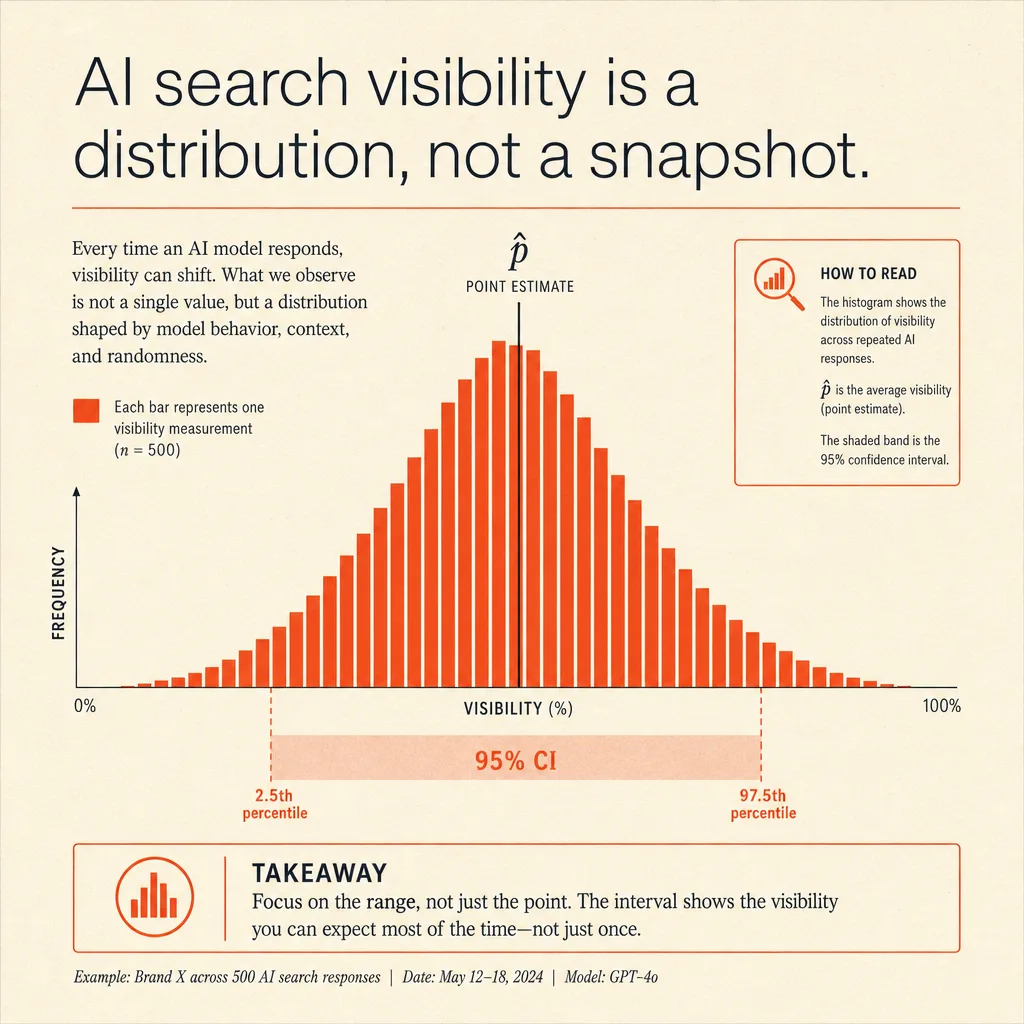
You put in the work to follow the steps we just covered. Now you need to know if it’s paying off. Measuring your brand’s AI search presence isn’t like checking a Google ranking. AI engines don’t have a dashboard. You have to test and track manually.
Manual testing: your first line of insight
Start with simple queries. Open each major AI search engine — ChatGPT, Perplexity, Google’s AI Overviews, Bing Copilot. Ask a question your target customer would ask. For example, “Best CRM for small businesses” or “How to choose a project management tool.”
Write down three things for each answer: Does your brand appear? What context is it in? Is the information correct? If your brand is mentioned but the facts are wrong, that’s worse than not being mentioned. Run these tests monthly. Track changes over time.
This takes about 30 minutes per month. It’s the cheapest and most direct way to see if your content is being pulled into AI answers.
Tools and KPIs for ongoing AI visibility measurement
Manual checks alone won’t scale. You need some tools and a few numbers to watch. Here’s a simple set of KPIs:
| Metric | What it tells you | How to track it |
|---|---|---|
| AI citation frequency | How often your brand is named in AI answers | Use tools like Brand24 or a custom search script |
| Sentiment | Whether mentions are positive, neutral, or negative | Read the context of each citation |
| Accuracy rate | Whether the facts about your brand are right | Compare AI output against your own data |
| Domain authority | A leading indicator of AI trust | Check via Moz or Ahrefs (not AI-specific but still useful) |
| Brand search volume | Organic interest in your name | Google Trends or Google Search Console |
The metric that matters most is accuracy rate. If AI gets your product specs or pricing wrong once, it loses credibility. Fixing that means updating your own sources — website, press releases, directories.
To measure effectively, you need both. Manual tests catch what tools miss. Tools give you scale. Run manual checks monthly. Review KPIs quarterly. Adjust your content strategy based on what AI is actually quoting.
That’s how to improve brand visibility in ai search engines — not by guessing, but by tracking what the models see and fixing gaps.
Frequently Asked Questions
How long does it take to improve brand visibility in AI search engines?
To improve brand visibility in AI search engines, expect 3–6 months for initial results. The timeline depends on how quickly you build authoritative mentions and consistent brand signals.
How can a small local business improve brand visibility in AI search engines?
Yes, a small local business can appear in ChatGPT or Gemini. improve your Google Business Profile, collect local reviews, and earn mentions on local news or blogs. These signals help AI models recognize your brand.
Is traditional SEO still worth doing for improving brand visibility in AI search engines?
Yes, because many AI models still train on web crawl data. Strong SEO foundations support your efforts to improve brand visibility in AI search engines by making your content discoverable.
How do I test if my brand shows up in AI search?
Manually ask AI chatbots about your brand and industry. Also use tools like BrightEdge AI Visibility or Authoritas to check your presence across different AI models.
What if AI search gives wrong information about my brand?
Correct the source data – your website, Wikipedia, or review pages – where the error originates. Some AI platforms, such as ChatGPT, accept feedback to fix errors. Monitor regularly.
Optimizing your brand’s presence for AI search engines requires a focused approach on structured data, natural language alignment, and authoritative content that answers user intent. By applying these principles consistently, you position your brand to appear in AI-generated summaries and voice search results. Ready to see how your brand appears in AI search? Request an AI Search Position Assessment.
Author
Mira Chen
Mira Chen studies how global brands appear in AI answer engines and turns that evidence into practical GEO workflows.